

Cloud computing has become an integral part of our lives in today’s modern world. The demand for efficient data transmission and storage has skyrocketed, and this has put a spotlight on the infrastructure that supports it. One crucial aspect of this infrastructure is the selection of the right fibre optic cable.
The choice between single-mode and multimode fibre optic cables can have a profound impact on the performance of cloud computing systems. Let’s explore the differences between these two types of fibre optic cables and how their selection can influence cloud computing.
Single-Mode Fibre Optic Cable
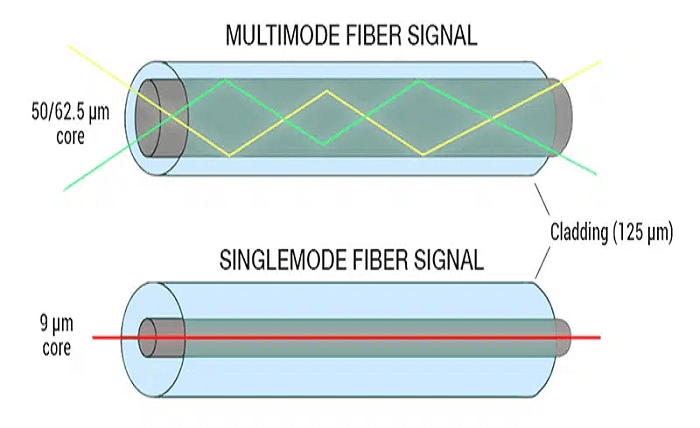
Single-mode fibre optic cable, as the name suggests, allows for the transmission of a single mode of light. It has a smaller core diameter compared to multimode cables, typically around 9 microns. This design allows for light to travel in a straight line, reducing the potential for signal dispersion and loss.
One of the primary advantages of single-mode fibre optic cables is their ability to carry data over significant distances with minimal signal loss. This is crucial in cloud computing, where data often needs to traverse vast geographical areas between users and data centres. The reduced dispersion and lower attenuation of single-mode cables ensure that data arrives at its destination with high fidelity, contributing to a seamless user experience.
Figure 1: Multimode Fibre vs Single Mode Fibre
Multimode Fibre Optic Cable
In contrast, multimode fibre optic cables have a larger core diameter, typically around 50 or 62.5 microns. This larger core allows for multiple modes of light to travel simultaneously, but it comes at the cost of increased signal dispersion and loss over longer distances. Multimode cables are generally more suitable for shorter-range applications, such as data centre connections and local area networks (LANs).
While multimode cables may not be the first choice for long-distance data transmission, they do have their own advantages in specific cloud computing scenarios. They are more cost-effective for shorter distances, making them a practical choice for interconnecting devices within the same data centre or between closely located data centres.
Impact on Cloud Computing
The choice between single-mode and multimode fibre optic cables can significantly impact cloud computing systems. Here are some key factors to consider:
- Distance and Latency: If your cloud computing infrastructure spans vast geographical regions, single-mode fibre optic cables are the way to go. They provide lower latency and less signal loss over long distances, ensuring that data reaches its destination quickly and accurately.
- Bandwidth and Scalability: Multimode fibre optic cables are well-suited for data centres and LANs, where high bandwidth is needed for connecting multiple devices in close proximity. They are cost-effective for these scenarios and can easily handle the high data demands of cloud computing within a confined area.
- Cost: Single-mode fibre optic cables are more expensive to install due to their precision and the need for laser-based equipment. Multimode cables are a more economical choice for shorter-range connections, making them a practical option for businesses looking to minimise costs while maintaining efficiency.
- Future-Proofing: When planning your cloud computing infrastructure, it’s essential to consider future growth and technological advancements. Single-mode fibre optic cables provide more room for expansion and are better equipped to handle future bandwidth demands, making them a more future-proof option.
Final Thoughts
The choice between single-mode and multimode fibre optic cables is a critical decision when building or upgrading your cloud computing infrastructure. Single-mode cables are the go-to option for long-distance, high-performance applications, ensuring minimal signal loss and low latency. On the other hand, multimode cables offer a cost-effective solution for shorter-range connections within data centres and LANs.
Ultimately, the decision should be based on your specific needs and budget. By carefully considering the factors mentioned above, you can select the right type of fibre optic cable to optimise the performance of your cloud computing system while keeping costs in check.
FAQs
What is the primary difference between single-mode and multimode fibre optic cables?
The primary difference between single-mode and multimode fibre optic cables is the size of their core diameter. Single-mode cables have a smaller core diameter and allow for the transmission of a single mode of light, while multimode cables have a larger core diameter and support multiple modes of light.
How does the choice between single-mode and multimode fibre optic cables affect cloud computing performance?
The choice of fibre optic cable impacts cloud computing performance in terms of distance, latency, bandwidth, and cost. Single-mode cables are ideal for long-distance applications, offering low latency and minimal signal loss. Multimode cables are cost-effective for shorter-range connections but may have limitations in long-distance scenarios.
Are there any considerations for future-proofing my cloud computing infrastructure when choosing fibre optic cables?
Yes, future-proofing is important. Single-mode fibre optic cables have more room for expansion and are better equipped to handle future bandwidth demands. When planning your infrastructure, consider your long-term growth and technology needs.